

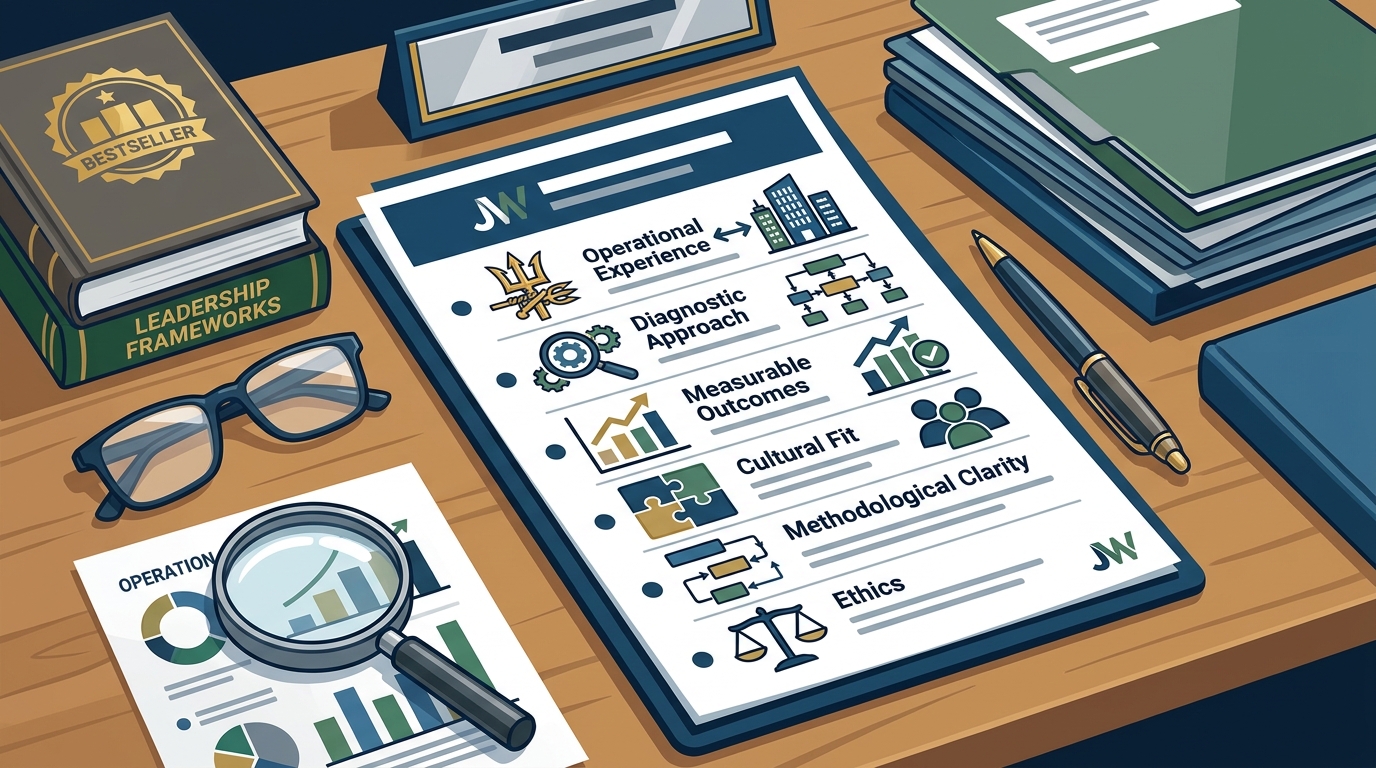
Executives should evaluate leadership consultants by verifying relevant operational experience, assessing their diagnostic rigor, and demanding measurable performance outcomes. This guide covers six critical criteria: relevant experience, diagnostic approach, measurable outcomes, cultural fit, methodological clarity, and ethics. It provides a framework for leaders to select partners who drive sustainable organizational change rather than temporary engagement. To begin this process, start your conversation.
Relevant Experience
Relevant experience is the practical application of leadership principles in environments that mirror the client's operational challenges. Executives must look beyond generic titles and verify specific domain expertise. A consultant who has led teams in high-stakes, high-pressure environments often possesses a depth of resilience and decision-making capability that purely academic backgrounds may lack. For additional details, review the leadership books.
Industry Specificity vs. Transferable Skills
While industry-specific knowledge is valuable, transferable skills in human performance are often more critical for leadership development. For example, Jacob Werksman brings a unique perspective as a former US Navy SEAL and Harvard Business School Executive Fellow. This dual background allows for the translation of elite military discipline into corporate strategy. Executives should ask candidates to describe specific crises they have managed and the frameworks they used to resolve them.
Verifying Operational Depth
Depth of experience is verified through case studies and client testimonials. Look for evidence of sustained impact rather than one-off engagements. A strong consultant will have a track record of working with high-performance groups. This indicates an ability to operate at the highest level of organizational complexity.
Diagnostic Approach
A diagnostic approach is the systematic process of assessing an organization's current state before prescribing solutions. Effective consultants do not arrive with a pre-packaged solution; they arrive with a framework for discovery. This phase is critical because it ensures that the intervention addresses root causes rather than symptoms.
The Importance of Data-Driven Assessment
Modern leadership consulting relies on data to identify gaps in performance and culture. Consultants should utilize validated psychometric tools, 360-degree feedback mechanisms, and direct observation. The goal is to create a baseline of current capabilities. Without this baseline, it is impossible to measure progress or determine if the intervention is working.
Customization of the Diagnostic
Executives should evaluate how a consultant tailors their diagnostic tools to the specific organization. A one-size-fits-all approach often fails in complex corporate environments. The consultant should demonstrate an ability to adapt their assessment methods to the company's unique structure, industry, and strategic goals. This flexibility is a key indicator of a sophisticated practice.
Measurable Outcomes
Measurable outcomes are the quantifiable results that demonstrate the return on investment of a leadership development program. Executives must move beyond subjective feedback and demand hard data. This includes metrics related to employee retention, productivity, revenue growth, and cultural health scores.
Defining Success Metrics
Success metrics should be defined collaboratively before the engagement begins. These metrics must be specific, measurable, achievable, relevant, and time-bound (SMART). For instance, a goal might be to reduce voluntary turnover in the leadership team by 15% within 12 months. The consultant should be comfortable committing to these metrics and providing regular reporting on progress.
Long-Term Impact vs. Short-Term Engagement
Executives should distinguish between short-term engagement and long-term transformation. A keynote speech may inspire, but it does not necessarily change behavior. A comprehensive consulting engagement should include follow-up support, coaching, and accountability mechanisms to ensure that the skills learned are applied on the job. This sustained support is what drives lasting change.
Cultural Fit
Cultural fit is the alignment between the consultant's values, communication style, and methodology and the client organization's existing culture. A mismatch in culture can lead to resistance from employees and a failure to implement new behaviors. Executives must assess whether the consultant's approach will be accepted by their team.
Assessing Communication Style
Communication style is a critical component of cultural fit. Some consultants use a direct, no-nonsense approach, while others use a more collaborative, facilitative style. Executives should consider which style will resonate with their leadership team. For example, a team that values autonomy may respond better to a coach who empowers rather than directs. The consultant should be able to adapt their communication to different audiences within the organization.
Values Alignment
Values alignment ensures that the consultant's core beliefs about leadership and performance are consistent with the company's mission. This alignment builds trust and credibility. If a consultant promotes a philosophy that contradicts the company's core values, the intervention will likely fail. Executives should discuss these values openly during the selection process to ensure compatibility.
Methodological Clarity
Methodological clarity is the transparency and logical consistency of the consultant's framework for delivering change. Executives should demand a clear explanation of the Learn more: Contact Start Your Conversation.